
A buyer’s guide to industrial dust collectors
Grinding dust is a health liability, a fire risk and — handled properly — a recoverable material. The specification decides which of the three you get.
Three reasons this line item pays for itself
Filtration efficiency
Airborne cast iron particles captured by an integrated high-efficiency extraction system.
Months to payback
Typical period over which recovered iron dust offsets the full cost of the collection system.
m³/h airflow
Extraction volume of a single DRXLD-3.0-B unit, enough to serve a pair of grinding stations.
Worker health and retention
Respirable cast iron and abrasive dust is a direct exposure hazard. Clean air at the grinding station measurably reduces turnover on the hardest jobs to staff.
Fire and housekeeping risk
Grinding throws sparks into a stream of fine metal dust. Uncontrolled dust settling on beams, ducts and equipment is both a fire load and a machine-wear problem.
Material recovery
Collected iron dust can be recycled back into the foundry production chain, turning a waste stream into recovered material value.
Six things to get right before you buy
Airflow, matched to the hoods
Size by the capture velocity you need at each hood, then add duct losses. Undersized airflow is the single most common reason a collector disappoints.
Filtration efficiency and accuracy
Efficiency alone is meaningless without particle size. Ask for both — for example ≥ 99.9% at 10 µm — and confirm it is measured, not nominal.
Filter area and air-to-cloth ratio
Divide airflow by filter area. For fine metal dust with pulse cleaning, roughly 1.0–1.5 m/min is a healthy range. Too high and filters blind early.
Cleaning method
Pulse-jet self-cleaning holds airflow steady through the shift and suits continuous duty. Manual shake-down units are cheaper but drift as they load.
Fire and explosion safety
Ferrous grinding produces sparks. Specify spark arrest and never mix aluminium or magnesium dust into an iron dust stream — that combination is genuinely dangerous.
Service life and running cost
Filter cost and availability, ease of element access, compressed air demand, noise level and footprint. These decide the cost of ownership, not the purchase price.
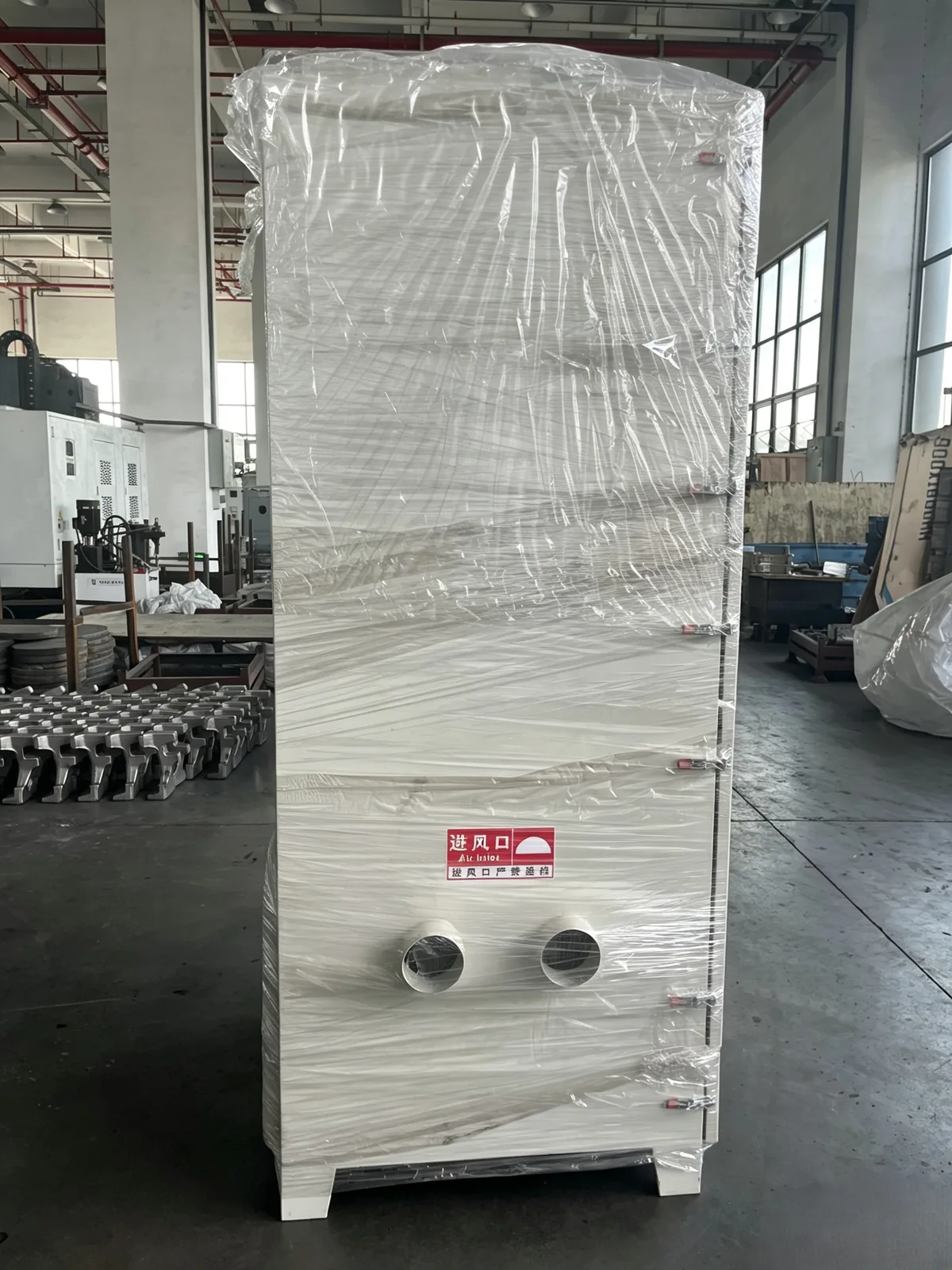
A worked example: DRXLD-3.0-B
What each line on the data sheet is actually telling you.
| Specification | Value | What it means for you |
|---|---|---|
| Rated power | 3 kW | Fan motor size — check it against your supply and duty cycle |
| Blowing rate | 2,700 m³/h | Enough for around two grinding stations with short, well-designed ducting |
| Filtration efficiency | ≥ 99.9% | Quoted with the accuracy figure below — always read the two together |
| Filtration accuracy | 10 µm | The particle size at which that efficiency is achieved |
| Filtration area | 32 m² | Gives an air-to-cloth ratio of about 1.4 m/min — comfortably in range for fine metal dust |
| Cleaning method | Impulse (pulse-jet) | Self-cleaning, so airflow stays stable across a full shift |
| Power supply | 3N 380 V / 50 Hz | Confirm against site supply before ordering |
| Air supply | 0.5–0.8 MPa | Compressed air is required for pulse cleaning — budget the compressor capacity |
Quick sizing check
2,700 m³/h ÷ 32 m² ≈ 84 m³/h per m²
≈ 1.4 m/min air-to-cloth ratio
The questions to put to any supplier
- What airflow do you recommend for my number of hoods, and how did you calculate it?
- What is the filtration efficiency, and at what particle size?
- What is the filter area, and what air-to-cloth ratio does that give at rated airflow?
- Is cleaning pulse-jet or manual, and what compressed air supply does it need?
- What spark arrest or fire protection is included for ferrous dust?
- What do replacement filters cost, and what is the lead time?
- Can the collected dust be recovered and recycled in my process?
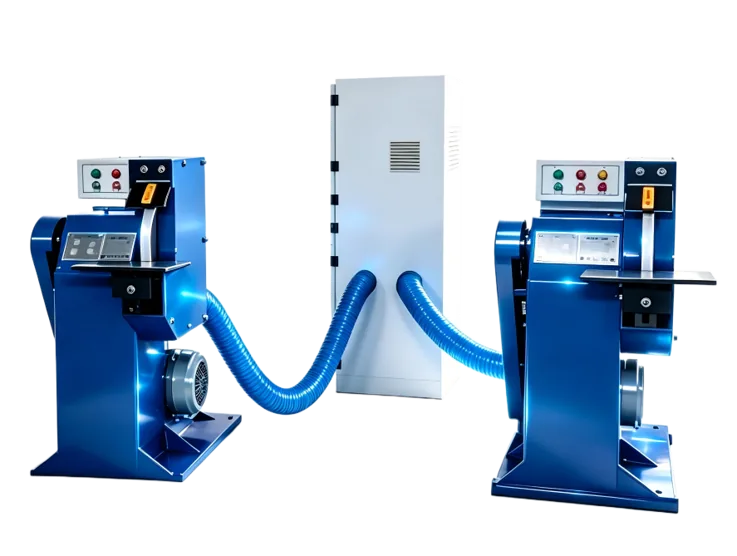
Specify the dust collector around your actual grinding line
Tell us how many grinding stations you have, your hood arrangement and expected dust load. DRATEC can size the collector, filter area and airflow together.
Request a Quote